FDA introduced the plausible mechanism pathway a few months ago (NEJM piece). Makary (FDA commissioner) and Prasad (FDA CBER head) wrote the following:
Once a manufacturer has demonstrated success with several consecutive patients with different bespoke therapies, the FDA will move toward granting marketing authorization for the product. Manufacturers will then be able to leverage platform data from such personalized products to gain marketing approval for similar products in additional conditions. Depending on the strength of evidence, either the accelerated or the regular pathway may be utilized.
But, what does this mean? What does it mean operationally for companies developing bespoke therapies for rare diseases? How many trials and what endpoints, surrogate markers, and controls will be sufficient? Recently, Makary and Prasad announced that FDA will default to one pivotal trial for approval not two. They cite the following list of factors that will influence their interpretation of a trial:
the magnitude of the effect, the use of a contemporary control group (versus a historical one), the nature of the control group (is it the best available therapy?), the prespecification of a hypothesis, the choice of a primary end point, the concordance with biologic correlates (including evidence of alteration of an in vivo target), alignment of intermediate end points, statistical power, blinding, concealment, independent review, whether post-protocol therapy is on par with the U.S. standard of care, the use of concomitant therapy, inclusion criteria, exclusion criteria, randomization, run-in periods, how missing data are handled, and many additional factors.
However, they do not offer a position on what evidence they would like to see for each of these factors with respect to rare diseases (where single pivotal trials with confirmatory evidence are more common). FDA, on February 23, 2026 released draft guidance for industry entitled “Considerations for the use of the Plausible Mechanism Framework to Develop Individualized Therapies that Target Specific Genetic Conditions with Known Biological Cause”. The entire 23 page document can be found here. The remainder of this post will be relevant highlights from the document mixed in with some commentary.
A therapy that qualifies for plausible mechanism pathway (PMP) must target the underlying pathogenic alteration behind a disease, show that it improves clinical course. The company should have data characterizing the natural history of the disease in untreated people. Data to show that the therapy actually targets the proximate pathogenic alteration must be presented. There should be evidence that the targeted genetic variant plays a CAUSAL role in the disease.
Natural history cohorts, if well put together, along with each treated patient acting as their own baseline can be an adequate trial design

This is a direct read through for companies that offer gene replacement, gene editing, and gene silencing. Of note, successful clinical data from one vector (e.g., viral vectors and lipid nanoparticle formulation) can be re-packaged with different editors/replacement therapies/silencers. This guidance makes it MUCH easier and easier to commercialize treatment for ultra-rare and rare diseases, respectively. This lines up with Makary’s statement that, “In short: We want to see more Baby KJs” (STAT News).

Cell line data showing appropriate on-target efficacy and lack of off-target effects will be sufficient for expanding applications. Technologies with known tail-risks are not as well positioned as relatively safe editing/silencing/replacement technologies. Specifically, I’m thinking of companies that introduce double stranded DNA breaks via Cas9.

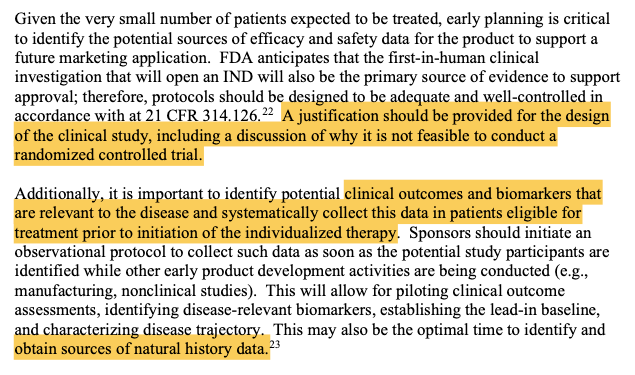
Arguably the most important section. If you can articulate why it is not feasible to run a RCT, FDA may not require one. Especially if you have a well-characterized natural history dataset and collect clinical and biomarker data before treatment starts. Off the top of my head, reasons for not needing an RCT would be that the disease is rapidly fatal, progresses too quickly, treatment is too invasive, or prevalence is so low that enrolling patients is impossible. Again, to make a compelling point for any of these reasons, a company will need solid natural history data, and data tying their specific alteration to the disease process.
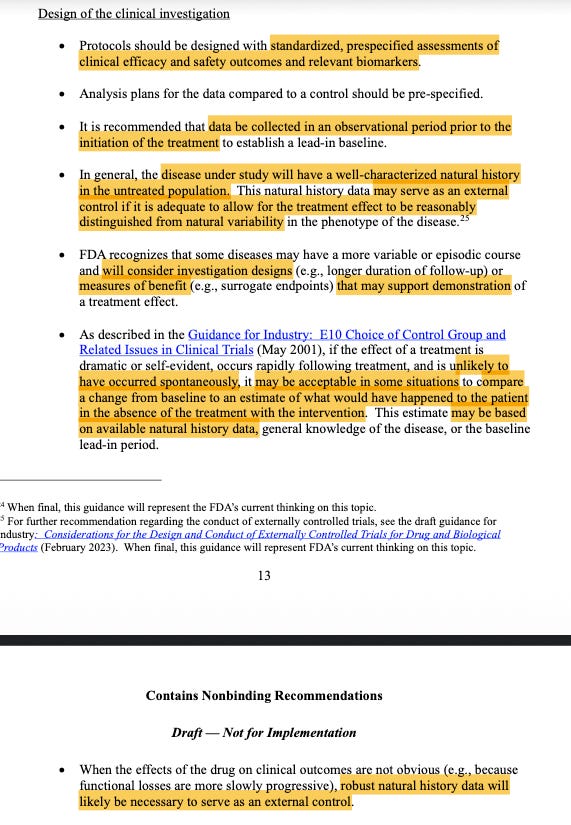
PRESPECIFIED protocols (relevant to those invested in uniQure). Anyhow, surrogate endpoints can be considered too, especially if that marker predicts clinical progression or outcomes reasonably well OR has been used in prior approvals (which we will see in the next highlight). Further, natural history can be used as external control if, for example, the outcome we are measuring takes a long time to manifest or slow. Cognitive outcomes are one such place.
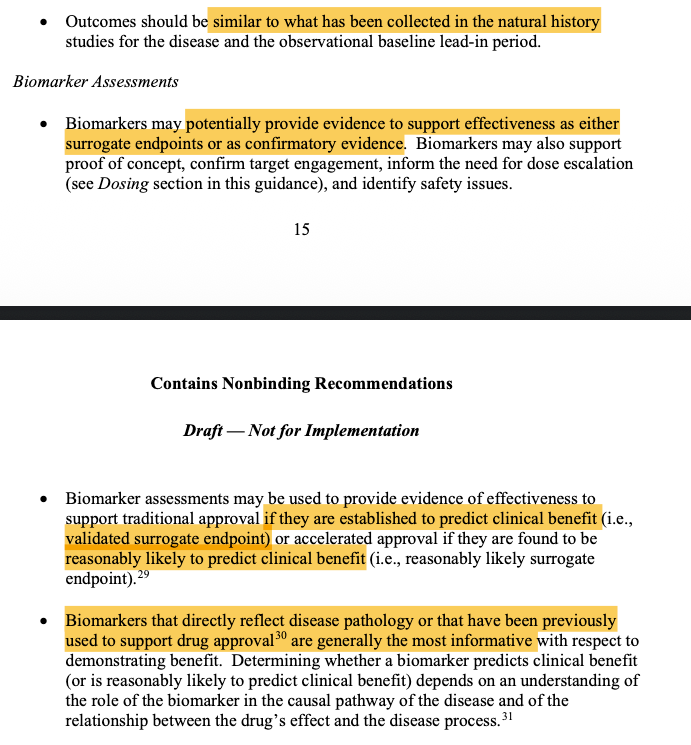
If using natural history, outcomes in the trial need to be HIGHLY concordant with those measured in the natural history data. It also goes without saying that the natural history patient population SHOULD REFLECT the trial population.
Also, biomarkers can be used if they are established to predict clinical benefit or likely to predict clinical benefit. One such example in the neurology space is NfL. QALSODY (ASO for ALS due to pathogenic SOD1 alterations) did not meet statistical significant primary endpoint measured by ALS functional rating score. Secondary points of plasma NfL reduction and CSF SOD1 protein level were significant. And, it was approved via accelerated approval in 2023.
“A benefit-risk assessment will be based on the data collected, considering
demonstrated benefits and adverse events, with consideration of the severity of
the disease and patient tolerance for risk”. How fast a disease progresses, other treatment options, and the demand by patients will be important.
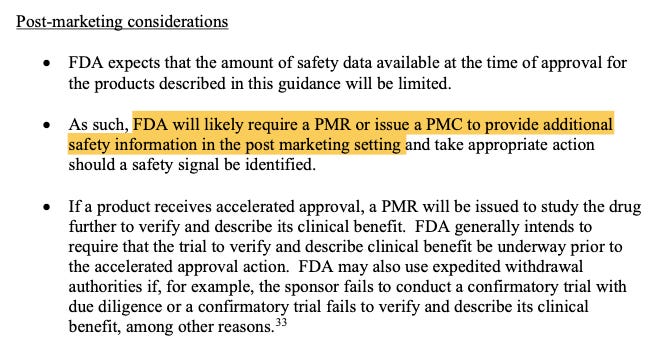
Postmarketing studies will be necessary for each therapy approved via PMP.
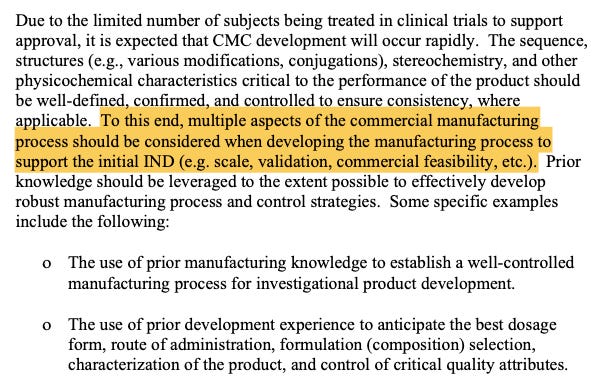
It will be critical to ensure that the manufacturing process is locked and commercial ready early in the process, possibly even pre-IND. CMC reasons lead to FDA CRLs. One recent example is ScholarRock’s Apitegromab for SMA which received a CRL solely for CMC reasons.