

What should it mean to be cured of cancer? Heart disease? Or, more generally, what should it mean to be cured of a disease? This post is mostly theoretical. But it may have some value in helping orient our thoughts. If we can arrive at a fairly precise definition of a cur, then we will have a clear target to aim at and optimize against. With that, let’s get started.
This talk was inspired Vincent Rajkumar’s talk “what is a cure in cancer?” which you can watch here.
Every person has their own quality-adjusted life expectancy curve. Consider Bob. At any given instant in time, he has a specific life expectancy value, informed by everything that he has done or happened to him up until and including that very instant. His life expectancy value can change. Suppose Bob gets cholera. His life expectancy at that instant drops a lot. But there also exists an unobservable life expectancy for Bob at that same instant if he did not get cholera.
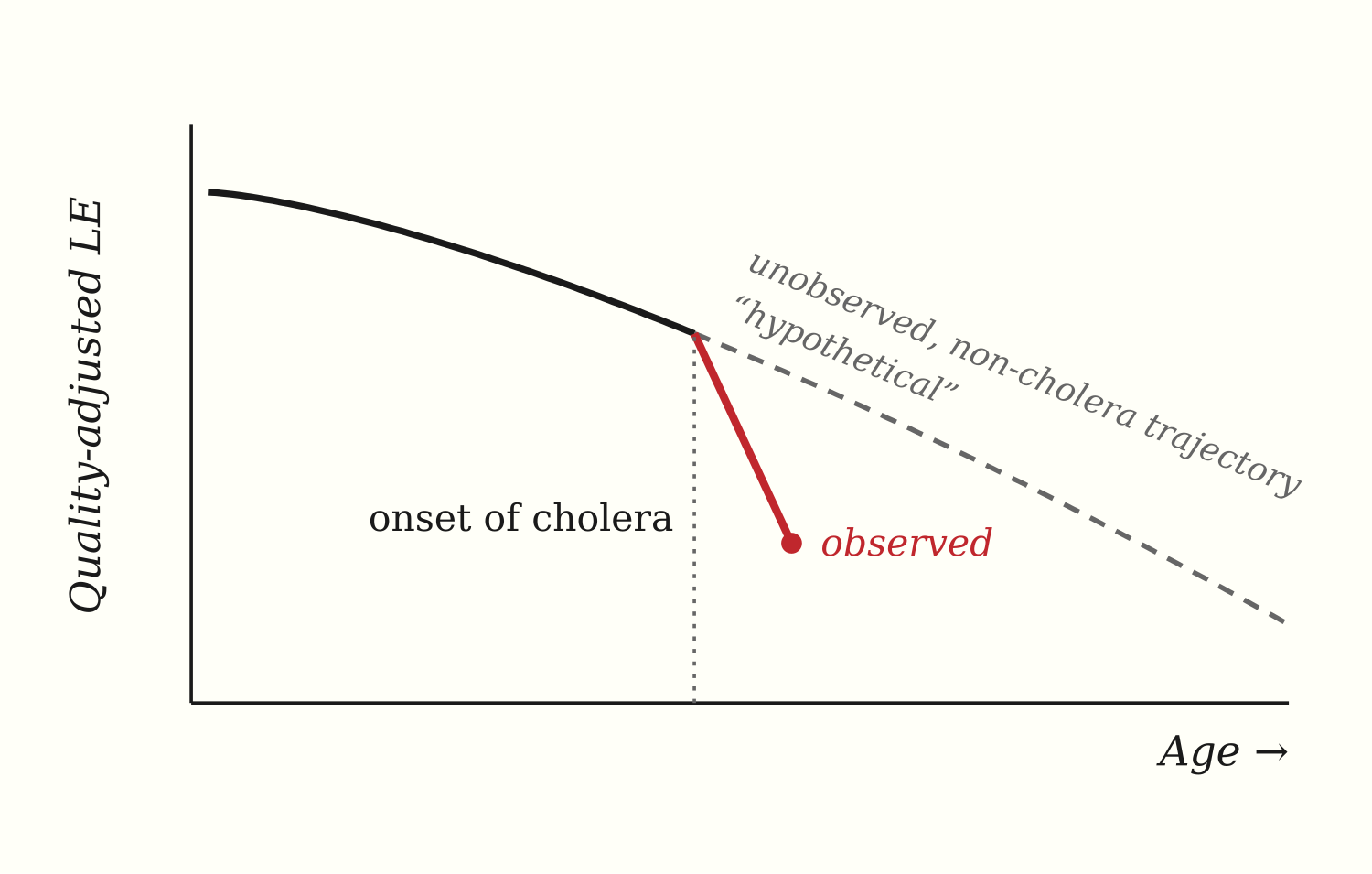
Now, in our observable reality, Bob has cholera and his life expectancy plummets. If he keeps adequately hydrated and electrolyte replenished and doesn’t suffer any serious cholera-associated sequelae, then his quality-adjusted life expectancy curve will return to that of his non-cholera path. This is a cure.
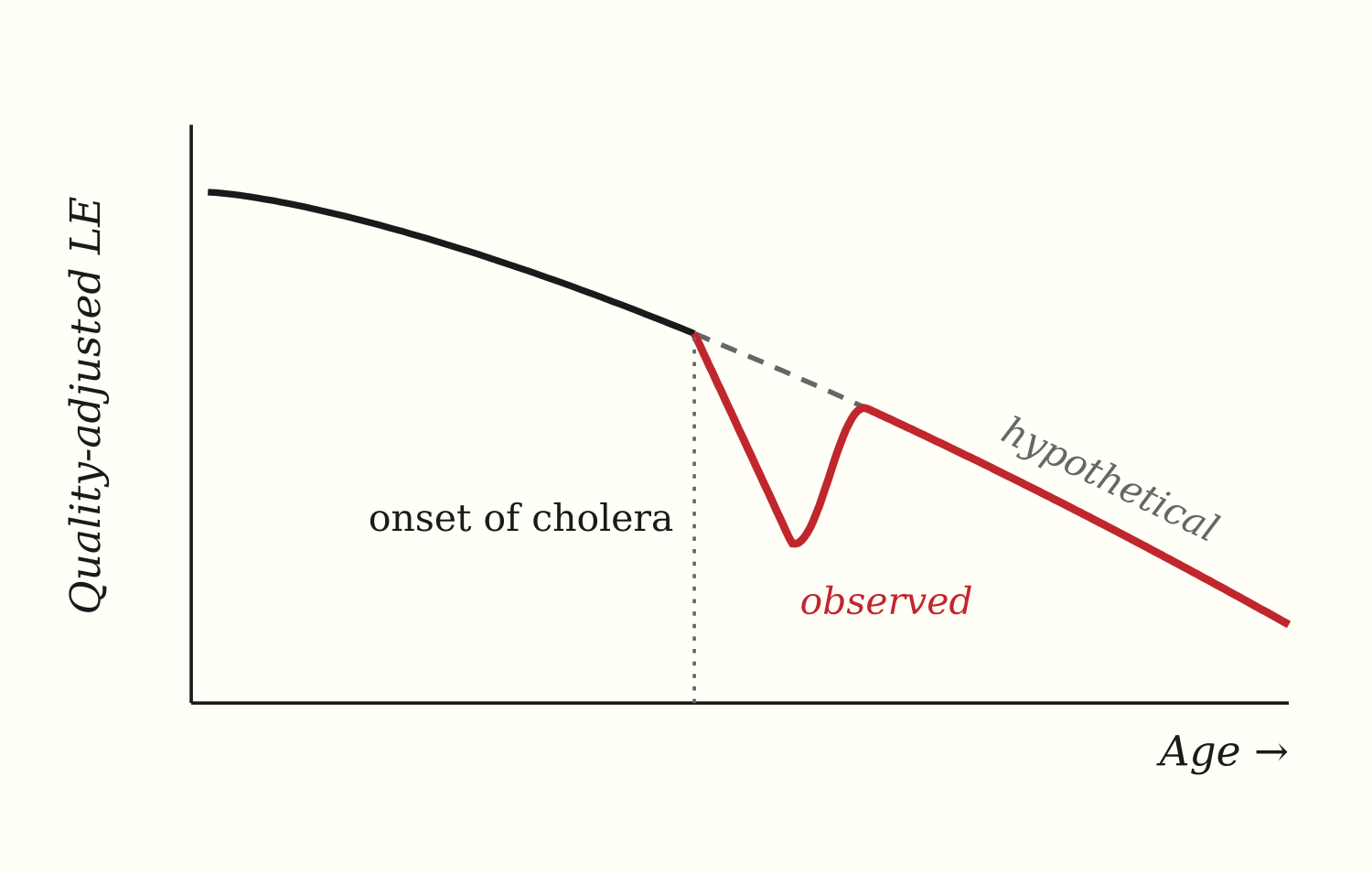
Note that his post-cholera life expectancy does not equal his pre-cholera life expectancy but rather matches the unobservable and unknowable non-cholera value. Time has passed, and therefore the post-disease value cannot be equal to the pre-disease value. For our example with cholera, the time that has passed is so small relative to the lifespan of a person that it is functionally the same, but it need not be. This is important when considering whether someone is cured after a long illness or if their life expectancy pre-disease is low.
Practically, using this definition, there is no way to know if someone is cured because the non-disease hypothetical can never be observed. We can try to estimate and model it, but it can never be known. One approach would be to build a digital representation of Bob’s health trajectory to understand the likely life expectancy path he would take if he did not get cholera. The limitation is that its accuracy will decay over time and must make assumptions about his behaviors and actions. Development and validation of such a tool will be difficult though it is becoming increasingly possible (e.g., digital twins). A simpler approach would be to assemble life expectancy curves of people similar to Bob. We can match on age, sex, socioeconomic status, and as many variables as we like (and are able to while maintaining statistical power) to arrive at a non-disease matched control curve. Bob returning back to this external control path is a more realistic and better definition of a cure. So, we can alter Figure 2 to reflect the external matched control line post-disease onset and the observed path Bob takes.
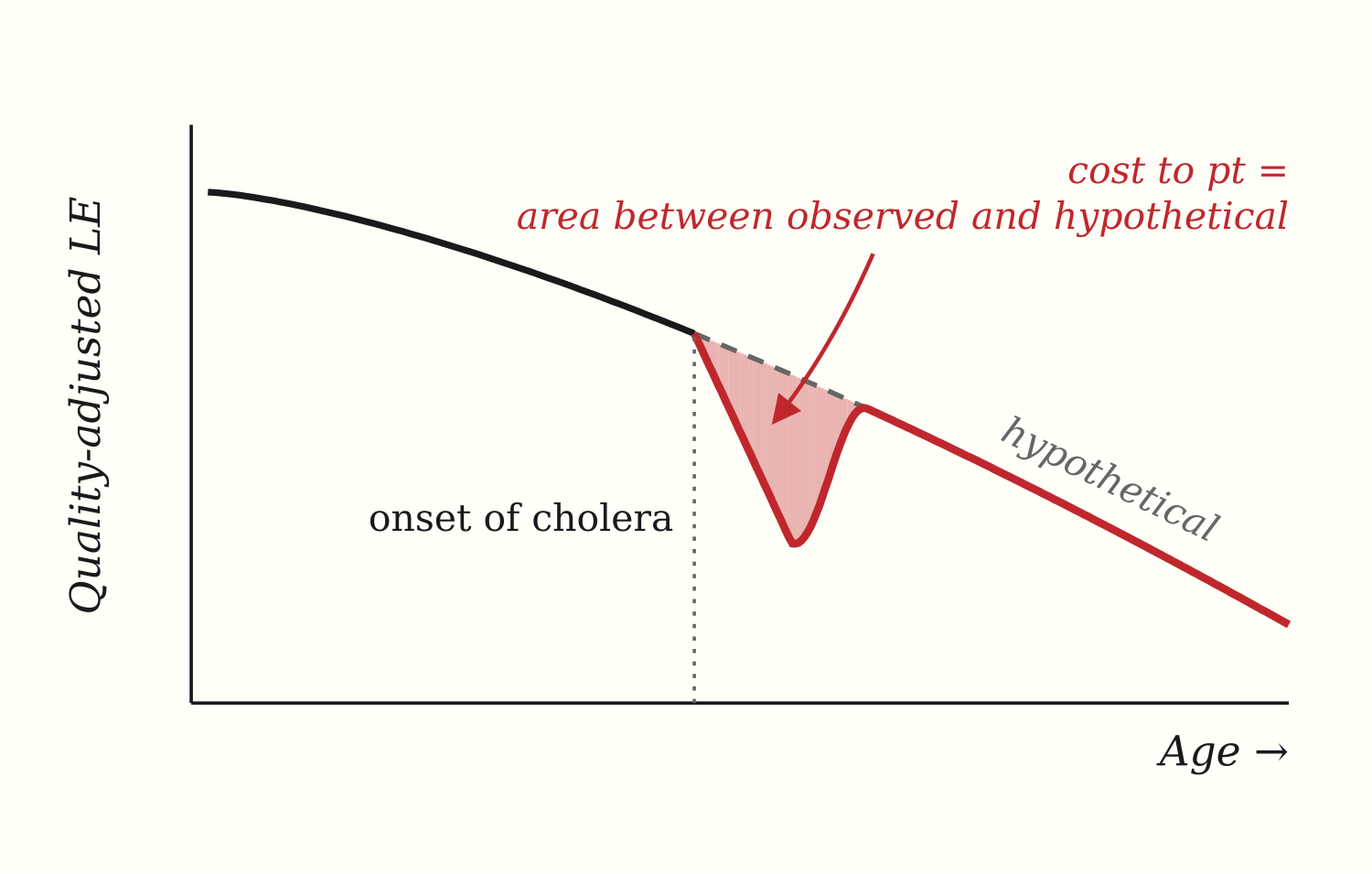
Bob ultimately ends up cured but it carries a cost to him. We can see this on the chart as the gap between the external control curve and his actual path. The area between these quality-adjusted life expectancy curves is a measure of the cost Bob experiences. The area quantifies, from the patient’s perspective, the quality of life decrement, adverse effects of the treatment, and toll of the disease. In a disease like multiple myeloma, for example, there are a small subset of patients that are cured with today’s therapies though these cures can have high costs to the patient.
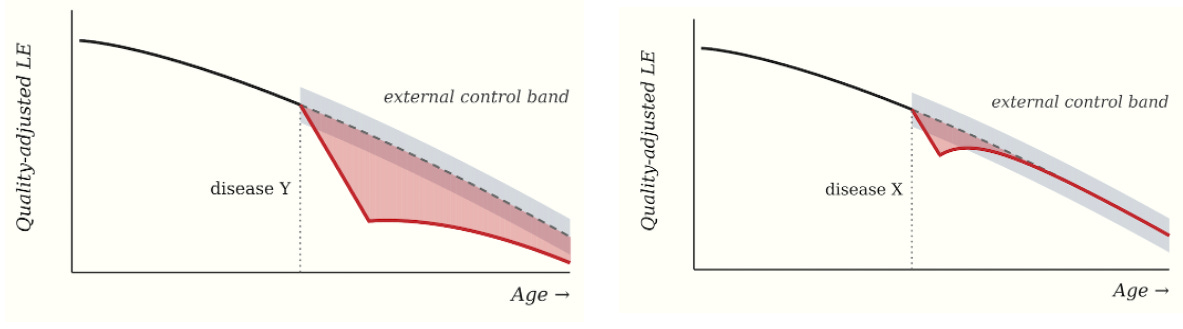
Our definition of a cure does not imply treatment must occur only for a fixed period of time. Returning and staying on the external matched curve is what matters, not the duration or type of treatment required to do so. Indefinite treatment, if acceptable to Bob, is a valid cure for Bob. The acceptability of the treatment to each patient will vary and if the treatment set is not tolerable for the patient, then no cure will be reached despite it being possible in principle (or in the aggregate). The most direct way to incorporate this notion of tolerability / acceptability is to measure quality-adjusted life expectancy. In practice, it can be hard to understand quality of life changes over time that a patient experiences because we don’t always have good measurement tools. These tools sometimes take the form of patient-reported outcomes instruments (e.g., KCCQ-23) or measuring some important parameter (e.g., 6-minute walk distance). And a “good” tool must 1) capture the patients’ experience, 2) capture what “success” would look like, and 3) have good performance characteristics like inter-rater reliability.
If time-variant quality-adjusted life expectancy curves cannot be jointly estimated, then we can compute life expectancy curves and separately measure quality of life (QoL). And the rubric for a cure would be composed of both QoL and life expectancy curves returning and staying to external control.
If Bob gets cancer, receives treatment, returns back to his normal QoL and life expectancy curve, and then 15 years later the same cancer recurs, he would not be considered cured. If Bob gets cancer, receives treatment, returns back to his normal QoL and life expectancy curve then 15 years later has a heart attack, Bob’s post-heart attack external QoL/life expectancy curves should be matched to folks cured of his specific cancer plus all his other relevant variables.
This is the end of the main part of the post, but I’ll close with some thoughts about the use of external controls in defining a cure (or other patient states). One of the issues with external matched controls is that any given person’s variables of interest change with time and so it’s hard to construct a control set that match people well enough through the time course of their life. Everyone has their own story. Concretely, Bob may have been born with a PCSK9 loss of function variant and raised in a high social vulnerability index (SVI) area. Then, he may have moved to a low SVI area, been employed at a high paying job and practiced yoga for 10 years. But then, he may have lost his job, started smoking 15 packs a day and live off a diet consisting of only Slim Jim’s. We do not adequately model Bob’s risk factors over time in part because the data and/or the outcomes are not available. Today, our construction of external control groups capture a single point in time or at most 2-3 points in time. However, today, there are reasons to believe we can do this at least a little bit better (e.g., wearables and AI).